Finding the stillness: why waiting matters during advent
As the calendar pages turn and the air chills, we find ourselves on the road to Christmas. Already, the festive rush is in full swing: shopping lists, party plans, and the pressure to have everything perfectly merry and bright. We live in a world that prizes instant gratification. We click, we buy, we stream, we scroll - everything is immediate, accessible, and often disposable.
But as the days grow shorter, have you ever felt a subtle, almost primal ache for something more? A longing beneath the tinsel and commercial cheer for a sense of depth, meaning, or even a touch of the magical?
It’s an itch that our culture of speed and certainty rarely scratches. We've lost the art of waiting - the profound, active discipline of looking forward to something truly transformative.
In the Christian tradition, Advent starts four Sundays before Christmas Day, this year on 30 November. Advent also marks the start of the liturgical year, a significant point on the church calendar. It is deliberately a time of preparation, not just for the Christmas break, but for something much larger.
Think of those beautiful, candlelit Carol Services many of us associate with the season. If you’ve ever been, there’s a hush, a certain sense in the church - a powerful feeling of quiet anticipation that has nothing to do with the gifts under the tree.
So it is that Advent is a dual act of waiting. The first of those acts of waiting is possibly an odd concept in that we are waiting for the past: commemorating the first coming of Jesus. While the second is waiting for the future: anticipating the second, future coming of Christ.
But Advent is also a time for purposeful pause in our otherwise frenetic lives. It invites us to stop, to look around, and to watch for signs of goodness and mercy already present in the world, while holding a hope for the coming of something better - a spiritual sense of renewal and ultimate peace. In essence, the point is this: the waiting itself is the gift.
The rush to get to Christmas often means we skim right over this essential time of preparation. In doing so, we bypass a crucial step in resolving a profound human dilemma: How do we make sense of a world that is all at once beautiful and deeply broken?
We've all felt the darkness, the injustice, the moments of confusion or loneliness, especially during a time meant for togetherness. We wrestle with the realisation that, despite all our technological advances and immediate access, there is a fundamental void - a hunger for a light that can truly pierce the gloom, a hope that can weather any storm.
Where do we find the assurance that goodness and mercy are not just abstract ideas, but active, powerful forces in the world? How do we locate the source of light that doesn't just illuminate the room, but defines all existence?
This is what the events of the first Christmas seek to resolve.
The New Testament writings associated with the season - particularly the opening of The Gospel of John and the Nativity account in The Gospel of Matthew (two of the historical accounts of Jesus’s life) - cut through the darkness with a radical answer. They provide an explanation of ultimate light and absolute hope.
The first chapter of John speaks of an essential force:
"...In him was life, and the life was the light of men. The light shines in the darkness, and the darkness has not overcome it."
This is a statement about existence itself. The ultimate source of all reality, this life and light, is not some abstract idea, but a defining presence that has entered human history. It suggests that this defining presence became tangible, that this light arrived in the fragile, human form of an infant.
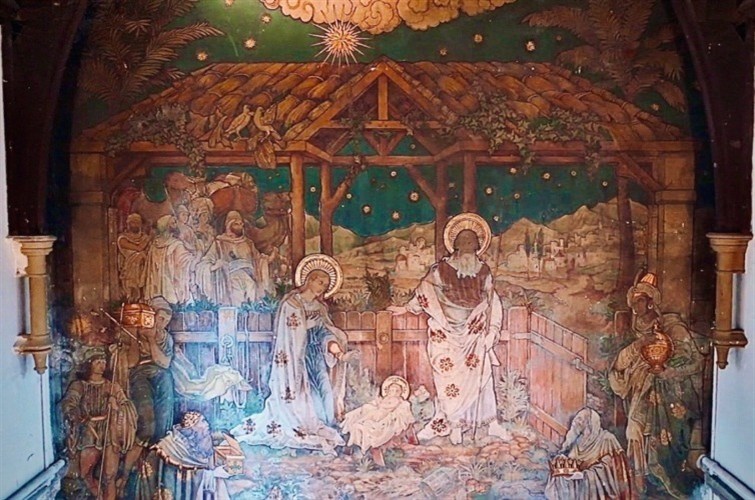
The Gospel of Matthew then gives us the story: the nervous anticipation, the journey following a star, the seemingly insignificant elements - the stable, the shepherds, the refugees' flight - that frame the arrival of the ultimate source of illumination.
For us Christians, we believe that Christmas is about Jesus, the light of the world, coming into the world. The Bible teaches that he did this to bring true and everlasting life for anyone who believes, through his death on the cross and resurrection at the first Easter. In this way, the Christian faith is that Jesus, the light, came to fix the brokenness of the world.
So, with that in mind, let's return to the concept I began with: waiting.
The waiting of Advent is what makes the light shine so brilliantly. If we rush straight to the celebration, we miss the vital significance - the truth about the origin of this light - that transforms the story from a historical event into a statement about the world's underlying meaning.
The core belief is that the light that existed in the beginning is what people of faith are truly waiting to acknowledge and receive. This is the most compelling aspect of the account of Christmas: that the ultimate reality arrived not as a conquering power, but in vulnerability.
So, as the world hurries toward 25 December, I invite you to step into the quiet, conscious space of Advent. Take a moment to allow yourself to feel that primal ache for meaning. Embrace the stillness, the anticipation, the profound and active art of waiting, goodness and grace.
Only by feeling the depth of the darkness can we truly appreciate the magnitude of the light that cannot be overcome. That light is, in the end, what makes the whole Advent and Christmas period special.
Why not join us for one of our services in the lead up to Christmas. More information can be found on our church calendar.
Louis Myers
Louis Myers, 04/12/2025